* Meaning of Arirang [Aɾiɾaŋ]
"The term Arirang is often translated as “my beloved one,” as some linguistic research supports that in ancient Korean ari meant “beautiful” and rang meant “the groom.” In addition, Arirang is said to be the name of a hill located in the central part of Seoul. (Kang, 2013, p. 32)."
"The term Arirang is often translated as “my beloved one,” as some linguistic research supports that in ancient Korean ari meant “beautiful” and rang meant “the groom.” In addition, Arirang is said to be the name of a hill located in the central part of Seoul. (Kang, 2013, p. 32)."
|
Preview
Arirang [Aɾiɾaŋ] has various versions in existence and the titles of the different versions are usually determined by their place of origin. Each Arirang presents regional differences in style, tune, lyrics, and rhythm (see videos in the previous page). (1) Gangwon Arirang (Dongbu Minyo) (2) Seoul or Geyonggi Arirang (Geyonggi minyo) (3) Miryaing Arirang (Dongbu minyo) (4) Jindo Arirang (Namdo minyo) The Arirang that most Americans are familiar with is called Seoul or Gyeonggi Arirang, given its origins in either Seoul (a capital city of South Korea) or in the Gyeonggi province that is near Seoul. |
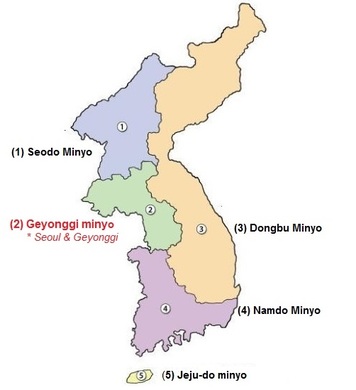
"Minyo" refers to Korean folksongs.
|
Singing "Seoul/Gyeonggi Arirang"
Arirang, Arirang, Arariyo,
|
|

| Arirang_sheet music.pdf |
Lesson Plan for Singing Arirang [Aɾiɾaŋ]
Grade Level: Grades 4-12, general music classes
Objectives:
· Students will be able to sing “Arirang” with appropriate melody and rhythm.
· Students will be able to sing “Arirang” close to the Korean vocal tone quality.
· Students will be able to sing “Arirang” with enthusiasm and energy during the entire song.
Duration: 30~45 minutes (or approximately one class period).
Procedures:
1. Teach the song with correct rhythms and pitches using the head voice.
2. Play the YouTube clip of “Arirang,” which is sung in a traditional Korean vocal style. (https://www.youtube.com/watch?v=gkM_LXUCMeA)
3. Explain about the traditional Korean vocal style to the students. Unlike the head voice in Western music (clear or light in quality), most Korean vocal production centers in the throat with vibrato (a rough, unpolished, and quavering sound). The sound is produced as the air is thrust upward from the stomach through the vocal chords.
Assessment:
Student singing can be assessed by adopting a performance test during the music class. To reduce student performance anxiety, the assessment can be embedded as a class activity.
1. Divide students into two groups: the singing group and the accompanying group.
2. Have one group sing Arirang while having another group accompany the Arirang.
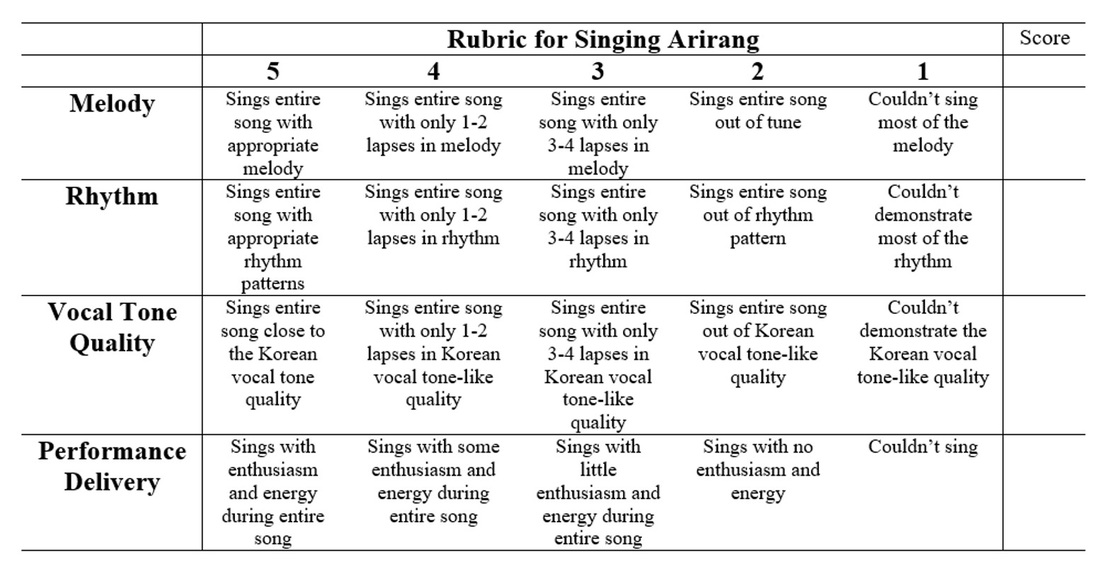
3. Observe the singing group and assess their performance skills using the rubric below.
4. Switch the groups' roles and assess the other group's singing using the rubric below.
5. Until the teacher finishes assessing individual's singing, repeat this procedure.